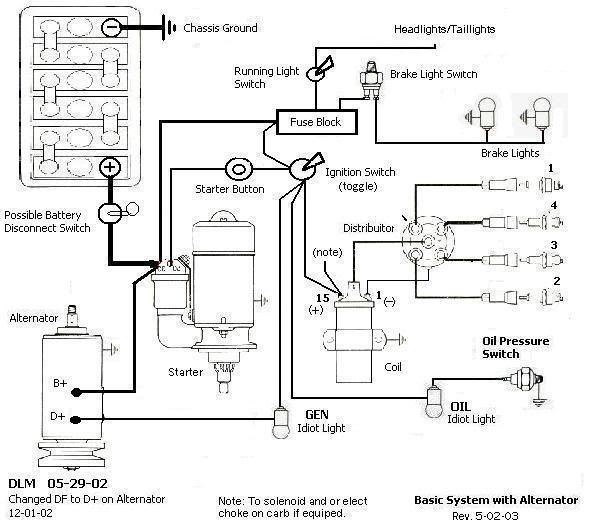
when is the ceramic resitor attached to the coil part of this diagram for the alternator?
or in another way.. WHY use a ceramic resistor on the coil with an alternator system
A ceramic resistor is used with some coils. It has nothing to
do with the alternator.
It's called a "Ballast" resistor. It limits the current drawn by the
Coil, especially when the engine isn't actually running.
Stock Bosch coils don't use a ballast resistor; the resistance is built
in to the coil winding. Many aftermarket coils do use a ballast
and it's important to use the correct one intended for a particular
coil model.
by the nature of speedy jim's reply.. my MSD coil came with the resistor.. therefore a this coil requires a ballast.
when is it usefull to use a ballast resistor.. why do some come with them and others do not?
does it prolong the life of the coil without sacrificing firepower?
Ballast Resistor: This is an electrical resistor that is switched in and out of the supply voltage to the ignition coil. The ballast resistor lowers voltage after the engine is started to reduce wear on ignition components. It also makes the engine much easier to start by effectively doubling the voltage provided to the ignition coil when the engine is being cranked. Not all car manufacturers used a ballast resistor in their ignition systems So you should check to see if yours does.
automobile engine component that lowers the supply voltage to the ignition system after the engine has been started. Because cranking the engine causes a very heavy load on the battery, the system voltage can drop quite low during cranking. To allow the engine to start, the ignition system must be designed to operate on this lower voltage. But once cranking is completed, the normal operating voltage is regained; this voltage would overload the ignition system. To avoid this problem, a ballast resistor is inserted in series with the supply voltage feeding the ignition system. Occasionally, this ballast resistor will fail and the classic symptom of this failure is that the engine runs while being cranked (while the resistor is bypassed) but stalls immediately when cranking ceases (and the resistor is reinserted in the circuit).
Modern electronic ignition systems do not require a ballast resistor as they are flexible enough to operate on the low cranking voltage or the ordinary operating voltage.