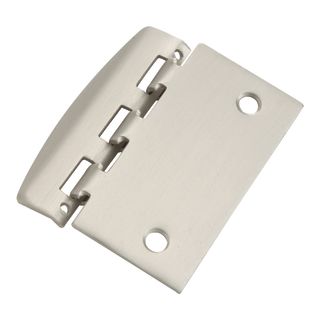
Got some relief from allergies for a couple of hours late in the afternoon yesterday so I got to do some fitting of the rear uprights for the box. The problem here is the lid of the box - when open does make things complicated. By removing the lid like the commercial boxes have, the build becomes a piece of cake. With the lid opening there has to be some detail (off-set of the seat support to accommodate the open lid) work done to support the seat mount.
Before I go much farther in design decisions (I am now back to my original design) I have to weld the base of the trolley together, drill then mount the caster pads to get a solid base for tacking the uprights and seat mount together for a fit check.
Options:
Since the box's lid pivots like it does the build gets complicated allowing for that. I could remove the lid and leave the top open for use (and to collect dust) which would make the build easier for sure. Other than the hinge the back of the box lacks strength but a doubler or only removing the pivot part of the hinge would solve that. Another good/bad problem is the slider that is attached to the lid that keeps the drawers closed when moving the box around. Removing that allows the drawers to slide around as they do not have locks or detents themselves; this is the good/bad part of the equation. The drawer hinges do allow the empty drawers to dance around a bit also but that has never been a real problem, just an observation.
By removing the lid the seat would be ~1 1/2 to 2 1/2 inches lower (depending on the handle; keep or remove) or one could still leave it at the same height and just have the top open which brings up the next question: do I pivot the seat pad or make it a lift off seat pad:
Pivoting: Pivot is added to tilt forward which is OK but is a bit awkward. Pivot to the rear is probably more normal hence comfortable.
Lift off seat: How do you keep the seat pad from sliding around. Either locating angle brackets/blocks on the bottom of the seat or posts going into holes on the rim of the seat frame. Removing the seat pad just puts another object on the floor to trip over if your distracted by what you are doing

(like I get).
Since haven't seem them in person there are several reasons to think if it the commercial units may not be that bad, cheap but the work is already done. I'm not sure about seat height and structural capabilities over the life of the units which may be a problem. Seat height possibly being low could be a problem if you are long legged or somewhat tall. Looking at their pictures they look to be built of a lighter material that I am using (scraps I have laying around mostly) hence a weight savings but... strength if you are a "chubby".... My unit is certainly going to be heavier but maybe that will help in cornering

. The wheels on the commercial
look to be of a smaller diameter than I am using which, if your floor has seams like mine does or a lot of cracks, the small wheel diameter can get stuck in them - they also help dictate seat height.
 . I need to make a slide-a-way table for some day,