Cooling system tests, week #2

This forum is for any discussion related to Aircooled Technology, the DTM shroud and Massive TypeIV engines. You may read and search this forum, but you can not post to it.
Baja Wes
Posts: 239
Joined: Wed Jun 05, 2002 12:01 am

Post by Baja Wes »

raygreenwood wrote:Baja wes. Yes...your fan calculations are common in most HVAC books. One thing you are missing is that those do not measure the "stacking" of all elements involved in any given fan installation.
yes Rpm and output are linear....or can be...but only in unducted form and with no restrictions...ie: head pressure, or supply duct being smaller in cross section than the max rpm flow rate of the fan...requires. The calculations show none of that.
Use that fan to start pushing air into the cooling manifold of a VW engine...or an AC duct with a large volume of air ahead of the fan....and numerous constricted duct openings (or any other number of examples)....and you will reach a point where the resistance on the output side of the fan...creates turbulence at the tips of the vanes.
Ray, you need to read what I tested again. Not calculated, tested. Not theoretical, but actual. I measured the flow of a vw fan, on a vw engine, while it was driven by the vw crankshaft, and was pushing air through the vw cooling system. And trust me, the flow was linear.

I know that a restriction causes a pressure head at the outlet of the fan. The head is a function of the velocity squared as with any friction loss. The power is the head times the flow, which is therefore proportional to the cube of the engine speed. This is all stated by the fan laws, I don't know what your getting at.

What is the point of what your saying? I have said the vw fan flow is linear up to 10,000 fan rpm. Do you dispute this?

I am trying to break the ridiculous myth that the vw fan gets to a certain rpm and cannot flow any more air, and stalls. This is non-sense. I have proven that.

My initial post was in defence of people having a go at me. If my comments were offensive I apologise.
Wes - http://www.offroadvw.net - 200HP Quad Cam V6 in a VW Baja - with climate control... :)
User avatar
raygreenwood
Posts: 11914
Joined: Wed Jan 22, 2003 12:01 am

Post by raygreenwood »

Wes, you did not offend me at all. Not poking at you. Just noting that something you said may be taken as offensive to someone else.

No...I am not doubting that a VW fan is linear in airflow up to 10K. I am doubting that it is linear when mounted on the engine and restricted by the cylinders and the cooling tin....because I have seen it to be restricted on the cars I work on. Yes....type 4 is different than type 1. That may be what I am seeing.

But...I think you made an assumption...that the belt begins to slip because the power ratio being imparted to it, was too high to allow properpower transfer without slipping...at high rpm.
It can also be slipping because of resistance on the fan.. built by head pressure.
To insure that theorem is correct...you must also have tested the belt and pulley system in a seperate test.....with NO FAN...just weight.....to 10k....for a comparative benchmark.
For a parrallel benchmark....you must also test the same fan on acrank mountedsystem with no belt and puley...to see if your theorem is true.

Thats what I'm getting at.

Your experiment and testing methods appear to be excellent. However, Like zydeco noted, I think there are some details that you listed that make it less than real world...or at least different than real world. Of course.....that would depend upon how you installed and drove with this fan combo. You could make what you drive fit how and what you are testing. Then in your application....I think you would be 100% correct. Ray

I am not doubting the efficency of the fan. I am doubting the restrictions that are inherent in the ducting of the engine
MASSIVE TYPE IV
Posts: 20132
Joined: Fri Jul 07, 2000 12:01 am

Post by MASSIVE TYPE IV »

I have never seen the TI fan stall, or seen any affects of it at any RPM...

The TIV fan does stall and you can see it easily. Thats why of FP engines we start puling blades out of the fan!
User avatar
BajaT4
Posts: 415
Joined: Fri Nov 29, 2002 12:01 am

Post by BajaT4 »

Jake is 100% correct about never seeing a VW fan go into stall. As long as the system doesn't change, and the fan design operating point isn't in stall to begin with, it will never stall. The fan will always operate on its system curve, designated in the example as SC below...

Image

This curve IS NOT the VW fan curve, only an example.

The Type 4 fan is a forward curve fan that operates at a much lower RPM which is why it is crankshaft connected. Run it up to a higher RPM (T1 range) and it will explode in a hurry. FC fan efficiency is poor.

The Type 1 fan is a backward inclined fan (actually a single width, single inlet plenum fan) that operates at about twice the RPM of a forward curve fan. What's good about BI fans is that they are one of the most efficient fans out there. So efficient in that depending on where you are in the fan curve, a higher flow rate may take less horsepower to turn the fan.

What Ray refers to as stack effect is typically referred to as "System Effect". Fans can be tested to all sorts of standards in the laboratory, but what really happens in the application itself can be dramatically different. This can most dramatically be seen on housed centrifugal fans where there is an elbow off of the fan discharge which rotates the airflow opposite to the fans direction of rotation. Now, system effect can happen on the inlet and the outlet of a fan. With the T1 fan housing so close to the firewall this could be a problem BUT the fan arrangement is pressurizing the fan housing in all directions so it can also intake in all directions without much loss. The same about system effect can be said for the discharge side of the housing as well but the airflow is fairly well controlled through a series of carefully directed vanes.

That all being said (if you're still reading!) the first fan law will still apply where RPM is directly proportional to CFM. The belt begins to slip because the horsepower required to turn the fan pulley has exceeded its design service factor. 911 fans slip much earlier because the contact area of the belt on the fan pulley is so small.
User avatar
raygreenwood
Posts: 11914
Joined: Wed Jan 22, 2003 12:01 am

Post by raygreenwood »

Baja...That last post makes a lot more sense to me. Sometimes my dis-understanding is in the detail of the explaination.

The problems I see in the type of fan I am running (type 4) are definately related to the pressure side ducting...and as Jake noted...blade spacing and the relative compression between them at high rpm. The problem is actually more related to restricted ingress of new air...by the spacin of the blades. The type 1 fan I realize, does not have that problem.
The type 1 fan housing also has less restrictions than the type 4. Less stacking...or system effect as you put it. Thanks for the information. Ray
Baja Wes
Posts: 239
Joined: Wed Jun 05, 2002 12:01 am

Post by Baja Wes »

raygreenwood wrote:No...I am not doubting that a VW fan is linear in airflow up to 10K. I am doubting that it is linear when mounted on the engine and restricted by the cylinders and the cooling tin
Ray, your missing my point. I tested the vw fan on a vw engine restricted by the cylinders and the cooling tin. So what your saying doesn't make sense. We're not understanding each other somehow.

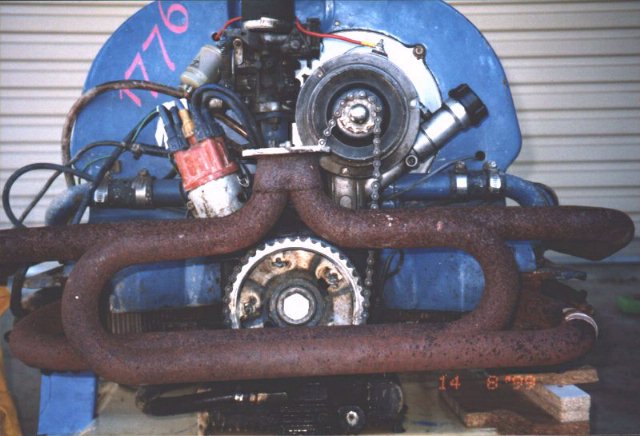
Here are some pics of the not so pretty, but functional test rig;

Image

And we did eventually find a solution to the fan belt slip, and that was to make the fan chain driven;

Image

The chain drive worked and we got some very high fan speeds, but the chain drive caused the entire rig to vibrate making measurements impossible and a little dangerous. So we went back to belt drive.

And someone asked about velocity profiles, I dug those up too.

Image

Image
Wes - http://www.offroadvw.net - 200HP Quad Cam V6 in a VW Baja - with climate control... :)
MASSIVE TYPE IV
Posts: 20132
Joined: Fri Jul 07, 2000 12:01 am

Post by MASSIVE TYPE IV »

interesting.... crazy thing is that when I went from the wide fan to the early fan engine temps did not change more tha 5 degrees over the engine, but since the oil cooler was not receiving as much air the oil did run hotter.
User avatar
raygreenwood
Posts: 11914
Joined: Wed Jan 22, 2003 12:01 am

Post by raygreenwood »

Wes, yes I got your point after the previous post. I did not fully realize though that you had it running with all of the internal restrictions. Interesting test. Even though both you and jake have never seen the type 1 fan stall....if the compression head gets high enough...it will stall. Not only does what you are sayin lead me to the conclusion that for the rpm range...the type 1 fan is more efficient....it also would point to a lot less restriction insideof the stock type 1 manifold as compared to the stock type 4.
Its also interesting to see the performance difference in the type and cant of the blades in the type 1 fan...as compared to what I know happens with the type 4 fan. The backward cant fan of the type 4...at least the blade design, is normally the most efficient of the three basic blade styles of centrifugal fan. It also has rpm limits due to that efficiency. It makes sense that it would be chosen run on the crank without benefit of the pulley multiplier. It probably would not survive a multiplier, and the resulting rpm, as you noted. This is also why Jake has probably found that removing blades, eases the stacking up of air immediately behind the point on the blades, where laminar flow begins. What I havn't had time to test, is with smoke, on the type 4 fan to get a visual confirmation of that assumption. I would need to test the fan without the restriction of the ductwork..to see if what I find happens, to the fan anyway.

It would be interesting to see the same testing on a type 3 stock manifold and fan. That is an interesting combination in itself. Ray
69bug
Posts: 1495
Joined: Sun Nov 18, 2001 12:01 am

Post by 69bug »

MASSIVE TYPE IV wrote:interesting.... crazy thing is that when I went from the wide fan to the early fan engine temps did not change more tha 5 degrees over the engine, but since the oil cooler was not receiving as much air the oil did run hotter.
jake, are you talking about the non-doghouse shroud?

how did it do?

did you try it with and without the oil cooler inside?

thanx
MASSIVE TYPE IV
Posts: 20132
Joined: Fri Jul 07, 2000 12:01 am

Post by MASSIVE TYPE IV »

Tried that too...

Just wait for it all to come out in the articles.. You'll see.
User avatar
Plastermaster
Posts: 2762
Joined: Sun Sep 30, 2001 12:01 am

Post by Plastermaster »

It seems the VW aircooled engine is kind of picky about its cooling. Think about other aircooled engines (excluding motorcycles). From lawn mowers to the 50HP wisconsin 4 cylinders, the cooling seems pretty simple compared to the VW. Maybe its becaus the cylinders are positioned so spread out...I don't know, just an observation.

Ron
MASSIVE TYPE IV
Posts: 20132
Joined: Fri Jul 07, 2000 12:01 am

Post by MASSIVE TYPE IV »

Harleys also overheat the rear cylinder... especially old ones..

The TI is MUCH more picky about its cooling than a TIV.. Must be the added fins and bigger area.
User avatar
BajaT4
Posts: 415
Joined: Fri Nov 29, 2002 12:01 am

Post by BajaT4 »

Hey Jake, with the T4 DTM, do the stock under cylinder cool tins stay in place or get removed? I remember some discussion about that a while back.
MASSIVE TYPE IV
Posts: 20132
Joined: Fri Jul 07, 2000 12:01 am

Post by MASSIVE TYPE IV »

You can use either, but we have found that the stock TI tins work best.
User avatar
dstar5000
Posts: 4555
Joined: Tue Feb 12, 2002 12:01 am

Post by dstar5000 »

Plastermaster wrote:It seems the VW aircooled engine is kind of picky about its cooling. Think about other aircooled engines (excluding motorcycles). From lawn mowers to the 50HP wisconsin 4 cylinders, the cooling seems pretty simple compared to the VW. Maybe its becaus the cylinders are positioned so spread out...I don't know, just an observation.

Ron
You are comparing apples to oranges.

IF the Vw engine was LEFT at 6.5CR and 26 HP(original design) it would NEVER overheat....
:lol:

Don
‎"Let me say it as simply as I can: transparency and the rule of law will be the touchstones
of this presidency,".. Barack Obama January 21, 2009, 30 minutes before he signed the law
sealing all his personal information....
Locked